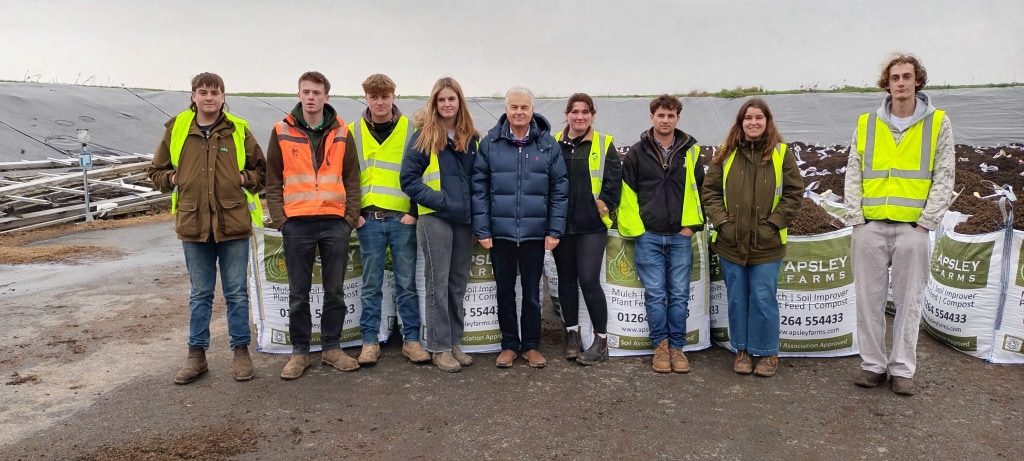
We love welcoming people to Apsley Farms, and a recent visit by a group of first-year crop technician apprentices at Sparsholt College gave us a great excuse to step back and reflect on just how much our 1,150-acre family farm has evolved over the years.
The students are studying as part of Sparsholt’s agricultural apprenticeship programme, and they came to see how a traditional farming business can grow into something quite different, while still remaining, at its heart, a farm.
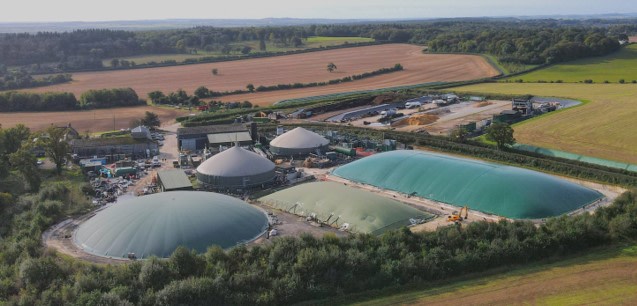
What started as a conventional arable operation has become one of the UK’s larger anaerobic digestion plants, producing biomethane and electricity for the national grid, sustainable liquid CO2, soil-improving mulch, and dry ice, all alongside the farming we’ve always done. It’s not one thing or the other; it’s everything working together.
During the visit, we took the group on a guided tour of our biogas plant, walking them through the full process from field to grid. That means starting with the crops themselves – maize, oats and rye grown using no-till techniques both here on the farm and by our contracted farming partners – right through to the biogas that gets upgraded and fed into the national gas network.
The plant consistently produces 114 gigawatt hours of biomethane a year, plus a further 9.4GWh of renewable electricity. To put that in context, the average UK home uses around 11,500kWh of gas annually, so we’re supplying enough to power roughly 10,000 homes – something we’ve been doing consistently for the last nine years.
The by-products from energy generation don’t go to waste – they go back into the land, improving soil health and crop performance.
It’s a genuinely circular process.
As our Chairman Henry du Val de Beaulieu put it, showing apprentices how we diversified to produce low-carbon products and create additional revenue streams, and seeing people connect the dots in real time, is one of the reasons we enjoy hosting these visits so much .
Helen Dougherty, Curriculum Lead for Apprenticeships at Sparsholt College, was equally enthusiastic. She described visits like these as invaluable; bridging the gap between theory and practice and highlighting the exciting developments within the agricultural sector.
About Apsley Farms